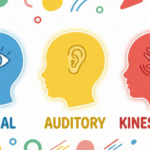
Visual learners retain information best through images, charts, and color-coding, whereas Auditory learners require listening, speaking, and mnemonic repetition to encode memory. Effective study hacks must match the child’s dominant sensory processing channel. To stop wasting hours on methods that do not stick, parents should first identify their child’s specific profile using a validated VAK assessment.
The “Hamster Wheel” of Homework
Is there anything more heartbreaking than watching your child study for hours, only to come home with a generic “C” on the test?
You see the effort. You see the flashcards, the highlighted textbooks, and the late nights. They are working hard, but they aren’t working smart. It feels like they are running on a hamster wheel—expending massive amounts of energy but going nowhere.
As a child psychologist, I often tell parents: It is not an intelligence problem. It is an input problem.
If your child is trying to download a “Visual” file into an “Auditory” operating system, the data will be corrupted. The hours aren’t the issue; the method is.
The Science: It’s Not About Being “Smart”
Cognitive science categorizes how brains process information into three main buckets, known as the VAK Model (Visual, Auditory, Kinesthetic).
While schools often teach in a “one-size-fits-all” format (usually lecture + text), your child’s brain has a biological preference for how it encodes long-term memory.
- Visual Processors: Need to see the concept. Their brain takes “snapshots.”
- Auditory Processors: Need to hear the concept. Their brain records “sound bites.”
If you force an Auditory learner to silently read a chapter three times, they might retain 10% of it. If you let them read it aloud once, they might retain 80%. That is the difference between a struggle and a breakthrough.
Signs & Symptoms: Which One Is Your Child?
Before you change their study routine, observe them. You don’t need a PhD to spot the clues; you just need to know what to look for.
Signs of a Visual Learner:
- They say “I see what you mean” or “Show me.”
- They are good spellers (they can “see” the word in their head) but forget names.
- They are easily distracted by visual clutter or movement in the room.
- They doodle in the margins of their notebooks.
- They struggle to follow long verbal instructions without a list.
Signs of an Auditory Learner:
- They say “I hear you” or “Tell me again.”
- They move their lips while reading silently or talk to themselves.
- They are easily distracted by background noise (TV, siblings).
- They remember names perfectly but forget faces.
- They enjoy music and can memorize song lyrics instantly.
3 “Non-Digital” Hacks to Try Tonight
Once you suspect a preference, pivot your strategy immediately. You don’t need iPads or expensive software; you just need to change the delivery method.
1. The “Color-Code” Map (For Visual Learners)
Stop asking them to write linear notes. Visual brains hate walls of text.
- The Hack: Use Mind Mapping. Have them draw the main concept in the center of a page and branch out with ideas.
- The Secret Sauce: Use color. Assign Green for dates, Red for key people, and Blue for definitions. Their brain will photograph the “colors” and recall them during the test.
2. The “Podcast” Method (For Auditory Learners)
Silent reading is often a waste of time for these kids. They need to hear their own voice.
- The Hack: Have your child record themselves reading their study notes or definitions on a phone voice memo.
- The Secret Sauce: Let them listen to their own voice while brushing their teeth or riding in the car. The brain prioritizes its own voice over anyone else’s.
3. The “Wall Teacher” (For Both)
This is the ultimate test of retention.
- The Hack: Buy a cheap whiteboard or tape a piece of paper to the wall.
- For Visual: Ask them to draw the concept for you.
- For Auditory: Ask them to give a speech explaining the concept to you.
- If they can’t teach it, they don’t know it.
Stop Guessing: The Danger of Misdiagnosis
While these signs are helpful, parental bias can lead to mistakes. You might think your child is Auditory because they talk a lot, when they are actually Kinesthetic (needing movement). Misdiagnosing the style can lead to even more frustration.
In a clinical setting, a comprehensive psycho-educational evaluation to determine these cognitive profiles can cost families upwards of $150.
We believe this data should be accessible to everyone. That is why we built the KidProsper Observation Assessment.
- No Stress for the Child: Unlike school tests, your child doesn’t take this one. You do.
- Observation-Based: You answer a series of guided questions based on your daily observations of your child’s behavior.
- Professional Grade: The app analyzes your inputs using established psychological frameworks to generate a clear profile.
- 100% Free: We offer this tool for free because every parent deserves the manual to their child’s brain.
Unlock Your Child’s “Easy Mode”
Stop the nightly battles. Get the data you need to help them study less, but learn more.