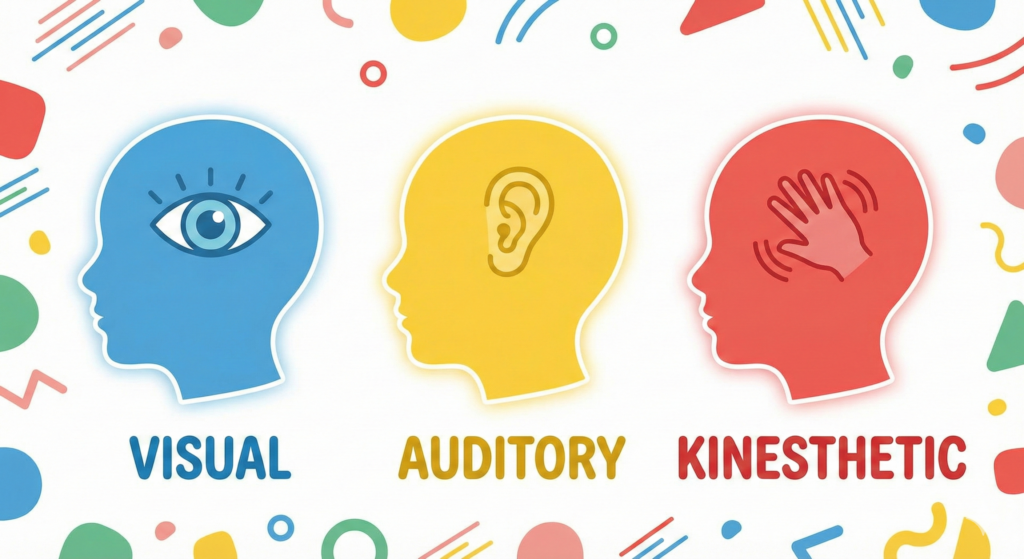
To find your child’s learning style for free, you must identify if they prefer processing information through images (Visual), listening and speaking (Auditory), or movement and touch (Kinesthetic). While observing their study habits helps, the most accurate method is using a validated VAK assessment tool, which is currently available at no cost through specialized educational platforms like the KidProsper app.
The “Dinner Table War Zone”
Does your kitchen table turn into a battlefield the moment backpacks are unzipped?
You know the scene: You are begging your child to just sit still and read the paragraph. They are sliding out of the chair, chewing on their pencil, or staring blankly at the page as if it’s written in alien hieroglyphics. You feel your patience fraying, and they feel like a failure.
As a child psychologist, I hear this story every day. Parents often fear their child is “lazy,” “defiant,” or struggling with a severe attention deficit. But more often than not, the problem isn’t your child’s ability to learn—it’s how the information is being delivered.
It is not a behavioral issue; it is a translation error. And fixing it starts with understanding their unique “Operating System.”
The Science: Why Textbooks Fail Certain Brains
Most traditional classrooms rely heavily on the Read/Write method. Teachers talk, and students read text. However, cognitive science tells us that every brain encodes information differently. This is known as the VAK Model:
- Visual (V): Learning through seeing (charts, colors, diagrams).
- Auditory (A): Learning through listening and speaking.
- Kinesthetic (K): Learning through touching, doing, and moving.
If your child is a Kinesthetic learner, forcing them to sit still and read a black-and-white textbook is biologically counter-intuitive. It’s like trying to run iPhone software on an Android device; the hardware is fine, but the system isn’t compatible.
5 Signs Your Child Has a Specific Learning Profile
Before you try to fix their study habits, look for these clues. Your child’s behavior during homework time is actually data.
- They can’t stop fidgeting (Kinesthetic): If they are tapping their feet, rocking in their chair, or need to hold something while listening, they likely need movement to activate their memory centers.
- “In one ear, out the other” (Visual): You give verbal instructions, and they forget them instantly. However, if you write it down or draw a map, they get it immediately.
- They talk to themselves (Auditory): You might catch them whispering while reading or needing to have background noise (humming/music) to concentrate.
- High physical intelligence, low “book” focus: They can build complex Lego sets without instructions or excel at sports, but struggle to write a three-sentence paragraph.
- Messy handwriting but great storytelling: Their brain works faster than their hand, causing frustration when trying to get thoughts onto paper.
3 Ways to Hack Homework Time Tonight
Once you have an idea of their preferences, stop fighting their nature and start leaning into it. Here are three free adjustments you can make immediately:
1. The “Walk and Talk” (For Kinesthetic Learners) Stop forcing them to sit at the table. If they need to memorize spelling words or history facts, have them bounce a ball back and forth with you while reciting the answers. The physical motion acts as a memory anchor.
2. The Highlighter Method (For Visual Learners) Black text on white paper is boring to a visual brain. Buy a pack of multi-colored highlighters. Assign a color to different concepts (e.g., Yellow for dates, Pink for names, Green for definitions). This turns a wall of text into a scannable map.
3. The “Teacher” Technique (For Auditory Learners) These children learn best by speaking. Ask your child to “teach” you the lesson they just learned. When they verbalize the concept aloud to you, they are encoding it into their long-term memory.
Stop Guessing: Why You Need a Validated Assessment
While your observations are valuable, it is easy for parents to misinterpret signs due to stress or bias. A child who looks away while you are talking might seem disrespectful, but they might actually be an Auditory learner turning their ear toward you to hear better.
In a clinical setting, a professional evaluation to determine these sensory preferences involves appointments, waiting lists, and costs upwards of $150 to $300.
However, we believe you shouldn’t have to pay a premium to understand your child. This is why we created the KidProsper Observation Assessment.
- It is scientifically backed: Based on established educational psychology principles, translating your daily observations into a clear cognitive profile.
- Zero pressure on your child: Unlike other tests, your child does not need to take this. You don’t need to force them to sit at a screen or answer questions. You simply answer a series of guided questions based on what you have observed at home.
- It is completely FREE: We include this tool in the free version of our app because we believe it is the foundation of all future learning success.
You are the expert on your child. We just give you the framework to understand what you are seeing.t another homework session end in tears. Get the data you need to advocate for your child’s educational needs.
Ready to Unlock Your Child’s Potential?
Stop the guesswork and start the growth. Download the app today and take the assessment in under 10 minutes.